
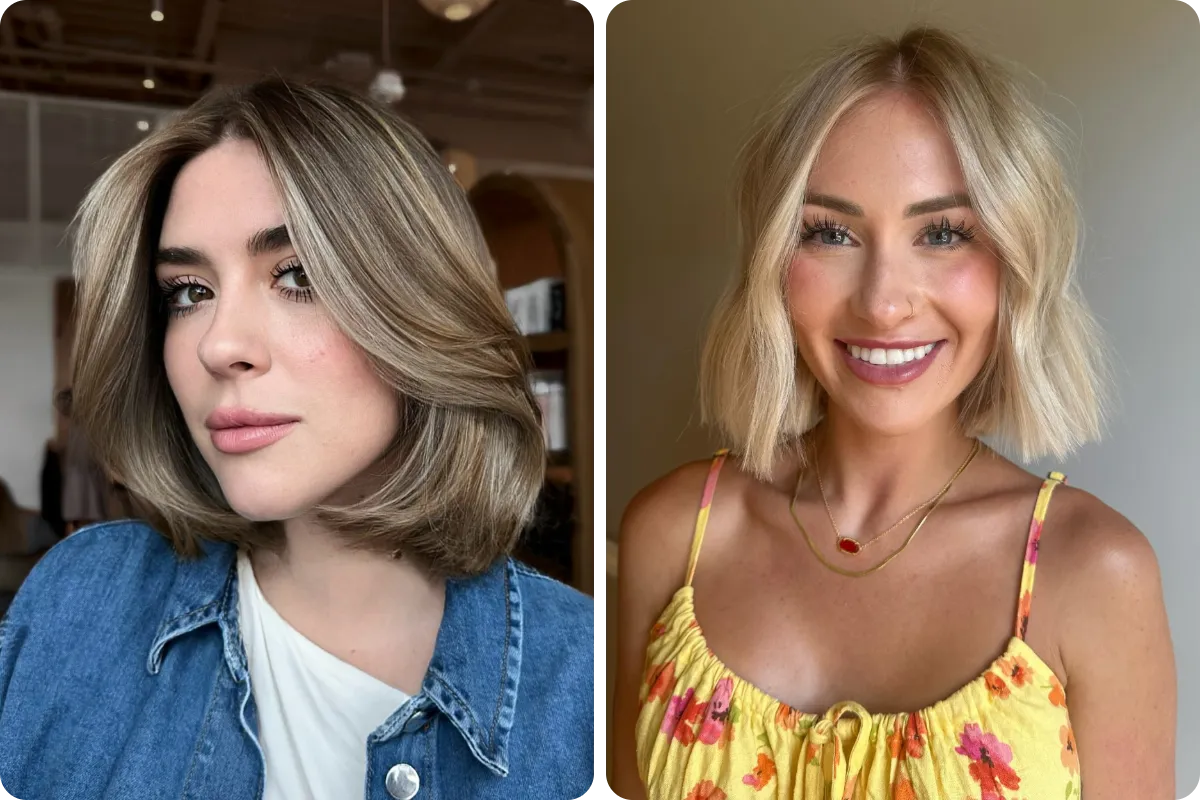
The hardest part of getting a bob is not deciding to cut your hair. It is finding the words for the cut you want once you are sitting in the chair. Short, but how short. Blunt, or broken up. With a fringe, or without one. Two women can ask for the same thing and walk out with completely different haircuts.
That is what this list is for. These 24 short bob haircut ideas cover the real range: sharp blunt lines that stop at the jaw, shaggy layered shapes with flicked-out ends, French bobs with a fringe cut high above the brows, curly bobs shaped on dry hair, angled cuts that sit short at the nape, and longer versions that still reach the collarbone.
Each one comes with the details that actually change the result. Where the length lands. Whether the ends turn under or out. How much layering the shape can take before it thins out. What it will look like eight weeks later.
Save the ones that keep pulling you back, and bring them with you.
1. Jaw-Length Blunt Bob With Soft, Undone Waves
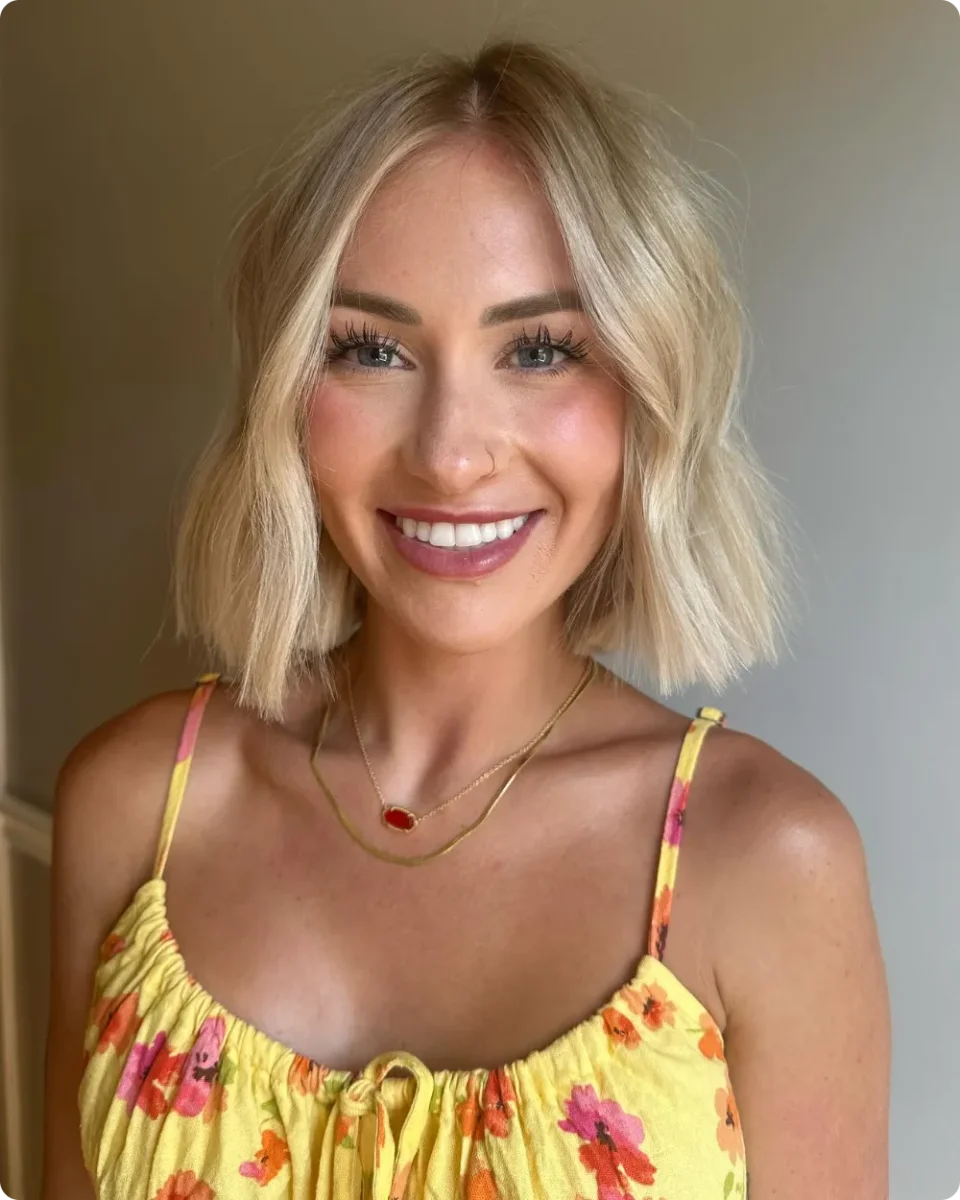
Blonde this pale can look stiff when it is styled too neatly. Here it goes the other way.
The cut lands just below the jaw and stays close to one length, so the ends look thick and solid instead of thin and wispy. The waves are loose and slightly uneven, with a few pieces flicking outward near the bottom rather than curling under in a neat row. A middle part keeps both sides even and lets the front pieces fall forward along the cheeks.
What to say in the chair: ask for a blunt line with the ends lightly point cut, not thinned out. That keeps the weight sitting at the bottom of the cut while the texture still moves.
The pale color helps too, since lighter ends catch the light and make the bends easier to see. On darker hair, the same cut reads sleeker and you will want a bit more bend to get the same effect.
2. Chin-Length Shaggy Bob With Flicked-Out Layers

Layers are doing all the work here. The length stops around the chin, but the shape sits wider and rounder than a blunt bob because the layers start high and get shorter toward the top.
The ends: most of them kick outward instead of curling under, which is what keeps this from looking like a grown-out trim.
The front: soft pieces fall across the forehead and split slightly to the side, so there is a fringe without a hard fringe line.
The color: warm golden blonde with a softer root, which stops the layers from looking choppy.
A round brush and a quick flick at the ends is really all this needs. Go too heavy with the layers on fine hair, though, and the bottom can end up looking see-through.
Bring this one in if your hair is thick and you are tired of it sitting flat and heavy.
Layers that start above the ear and stay soft at the ends.
Front pieces cut a little longer so they sweep instead of stick out.
Ends left slightly uneven on purpose.
Heavy thinning shears through the middle lengths.
A short, straight fringe across the forehead.
Styling every end under in the same direction.
3. Precision Blunt Bob That Curves In at the Jaw
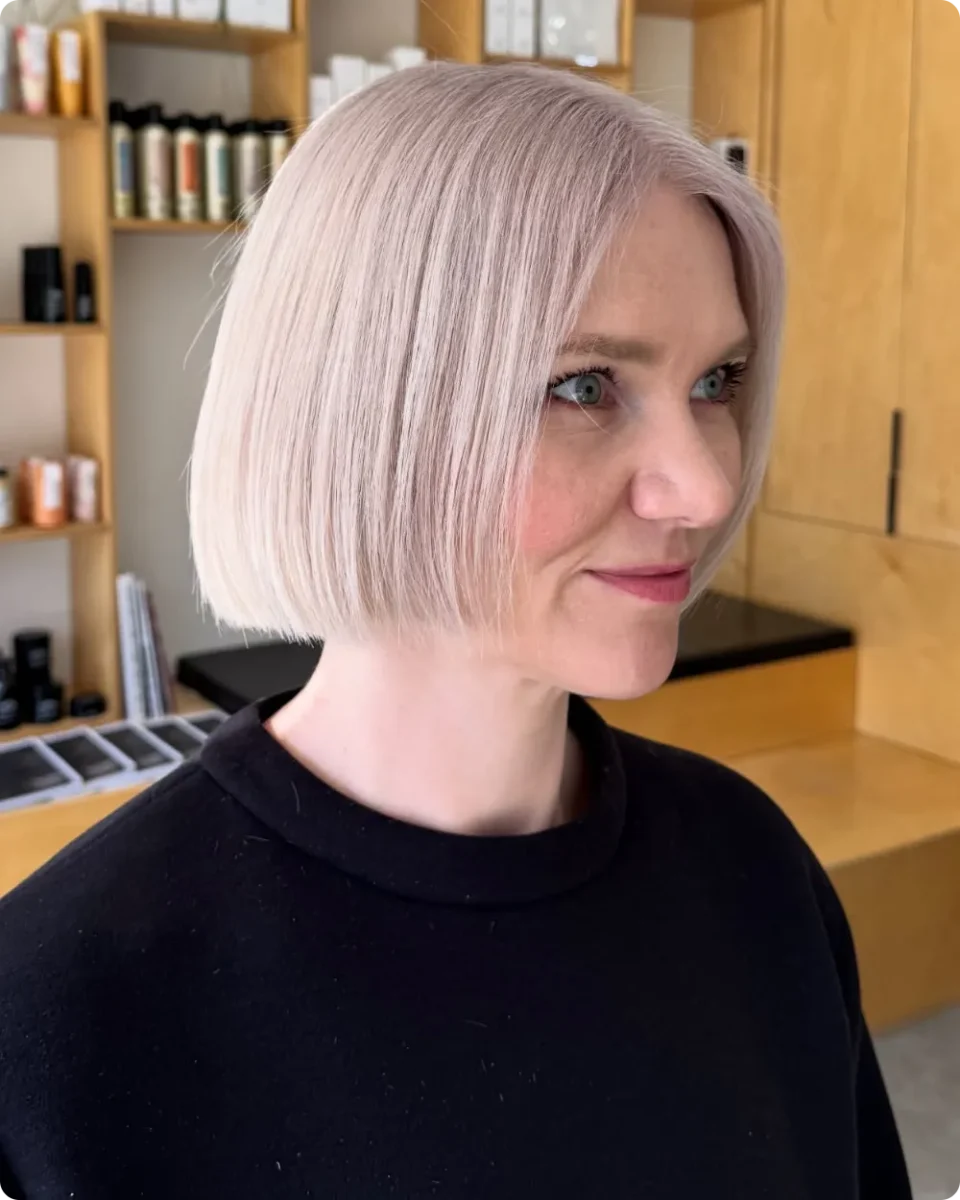
Straight, glossy, and cut with a razor-sharp line at the bottom. No layers, no texture, nothing hidden.
The shape is the whole point. It sits at jaw level and the ends turn in slightly toward the neck, so the outline curves rather than hanging flat. The side part sends a thick panel of hair across the forehead, which balances out the width at the jaw. Cool pearl blonde with a faint pink tone makes the shine easier to see.
Here is what to know before you book it: this cut shows everything. Split ends, uneven ends, a bad blow dry. It rewards good hair days and punishes lazy ones.
📌 Good To Know
A blunt line like this needs a trim every six to eight weeks. The second the bottom edge softens, the shape stops looking deliberate and starts looking like it is growing out.
4. Dark Textured Bob With a Wispy Fringe and Face-Framing Pieces
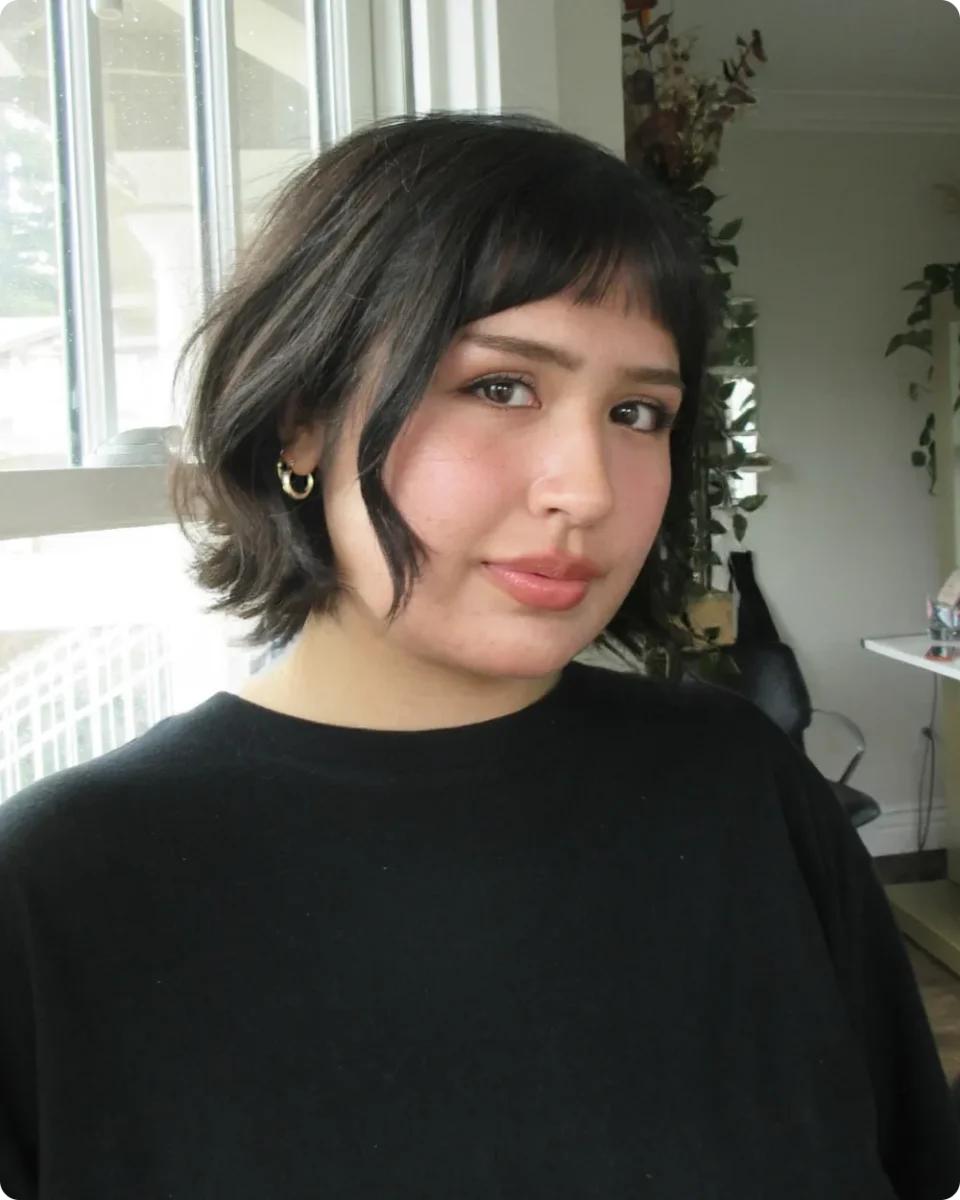
Dark hair holds a shape hard, so the trick here is breaking it up before it turns into a helmet.
Three things are happening at once in this cut:
- The length sits between the chin and the jaw, short enough to swing but long enough to tuck behind one ear.
- A soft fringe crosses the forehead with gaps in it, cut wispy at the ends rather than straight across.
- Long pieces on either side of the face drop past the fringe and curve in toward the cheeks, so the front never looks blocked off.
The ends have real movement, bending in different directions instead of falling in one smooth curve. That is a piecey, roughed-up finish, usually a little product worked through damp hair and then air dried.
One small thing worth copying: the fringe is left slightly longer than eyebrow level. That is much easier to grow out than a short one, and on a bad day it pins back without a struggle.
Work a texture cream or light paste through damp hair, roots to ends.
Scrunch the mid-lengths with your hands, then let it dry most of the way on its own.
Dry the fringe separately with a brush so it lies flat instead of separating into clumps.
Break up a few ends with your fingertips and leave the rest alone.
5. Rounded French Bob With a Short, Straight Fringe
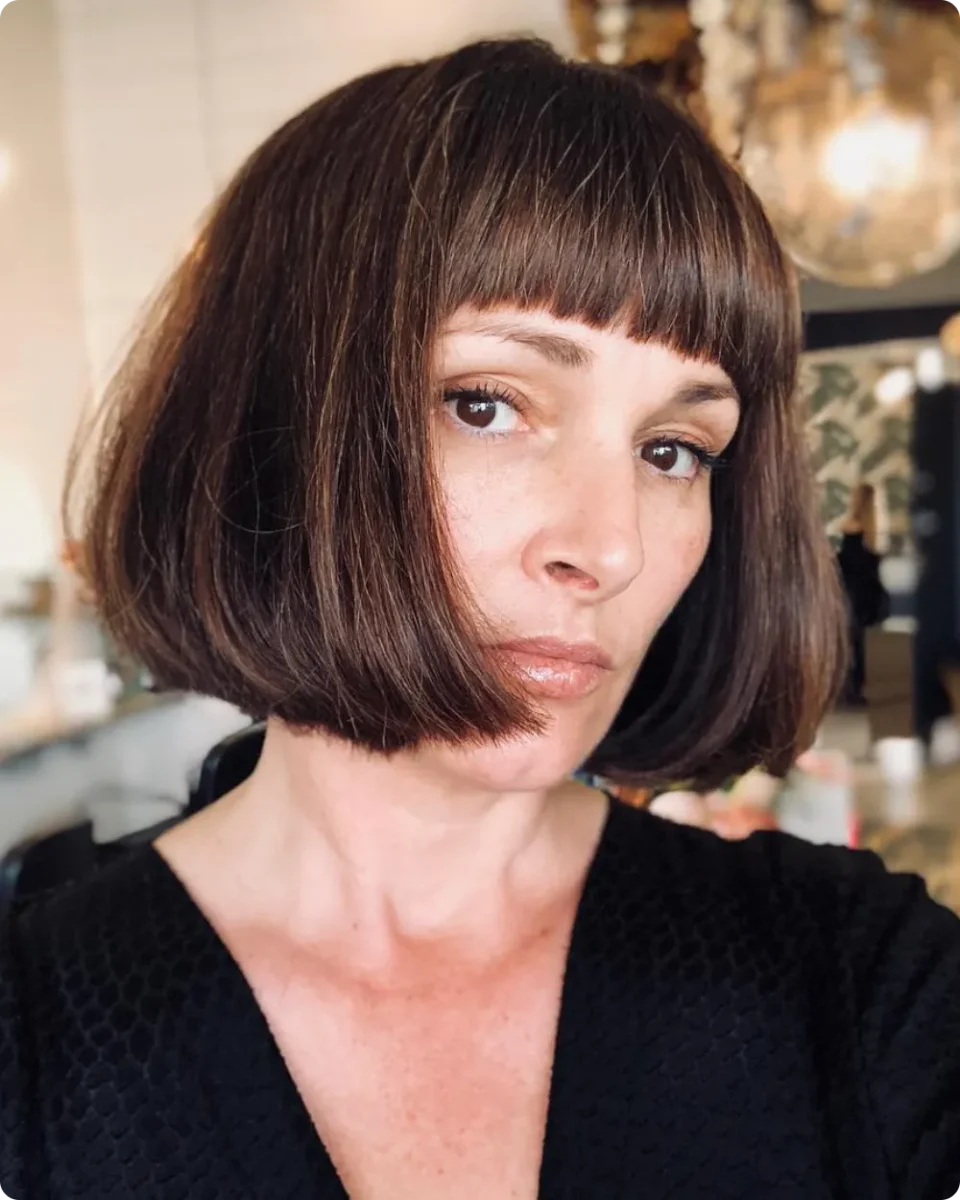
Two strong lines, and they hold each other up.
The fringe sits high, ending above the eyebrows and cut straight across with a slight dip in the middle. The length stops around the jaw with the ends tucking under, giving the whole thing a rounded outline rather than a flat drop. Warm chestnut brown with a bit of shine keeps it soft instead of severe.
The reason the short fringe works here is the length. Because the sides come forward and curve in near the chin, there is enough hair around the face to balance out all that exposed forehead. Try the same fringe on a much shorter cut and the proportions tip.
Worth being honest about the upkeep before you commit:
| What this cut gives you | What it asks of you |
|---|---|
| A strong, finished shape without any layering. | A fringe trim roughly every two to three weeks. |
| Fullness at the ends, good for medium and thick hair. | Drying the ends under with a brush most mornings. |
| A cut that reads as a real style, not just short hair. | Patience if you ever want to grow the fringe out. |
6. Copper Chin-Length Bob With Roughed-Up, Uneven Ends
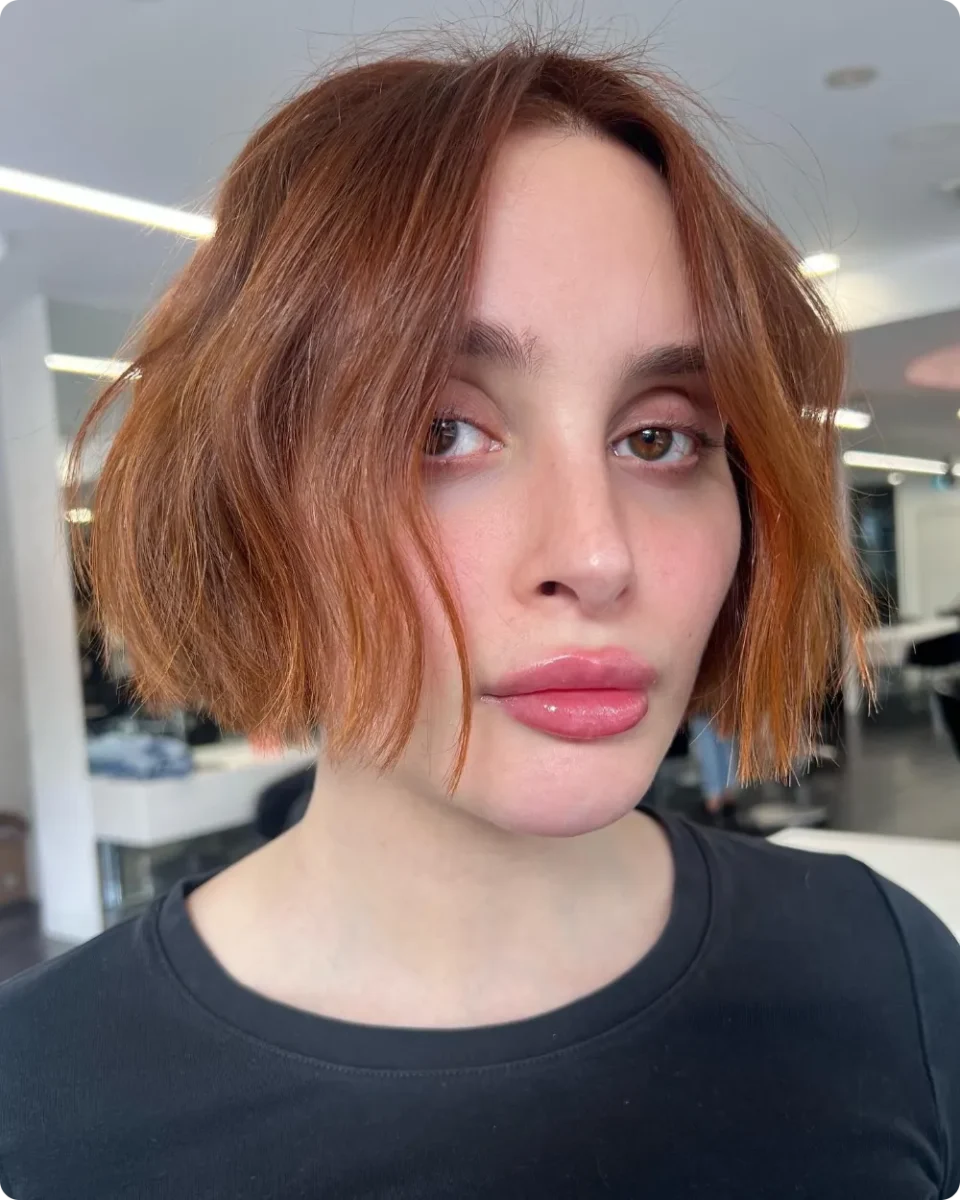
Undone on purpose, and there is a difference between that and messy.
The cut itself is close to one length, sitting right at the chin. What changes it is the finish. The ends are broken up and slightly ragged, some pieces shorter than their neighbors, so the bottom edge looks soft rather than sliced. A deep middle part lets both sides fall forward, and a few fine strands stay loose across the face instead of being smoothed back.
Warm copper is a big part of why this reads the way it does. Lighter ginger ends against a deeper root make the separation visible, and every broken piece catches light differently.
A note on hair type. This works best on hair with a bit of natural wave or coarseness. Very fine, very straight hair can end up looking thin at the bottom with this much texture removed, so ask for the ends to be point cut lightly rather than chopped through.
Words to use when you ask for this
7. Curly Bob With a Wispy Fringe, Cut for Natural Wave
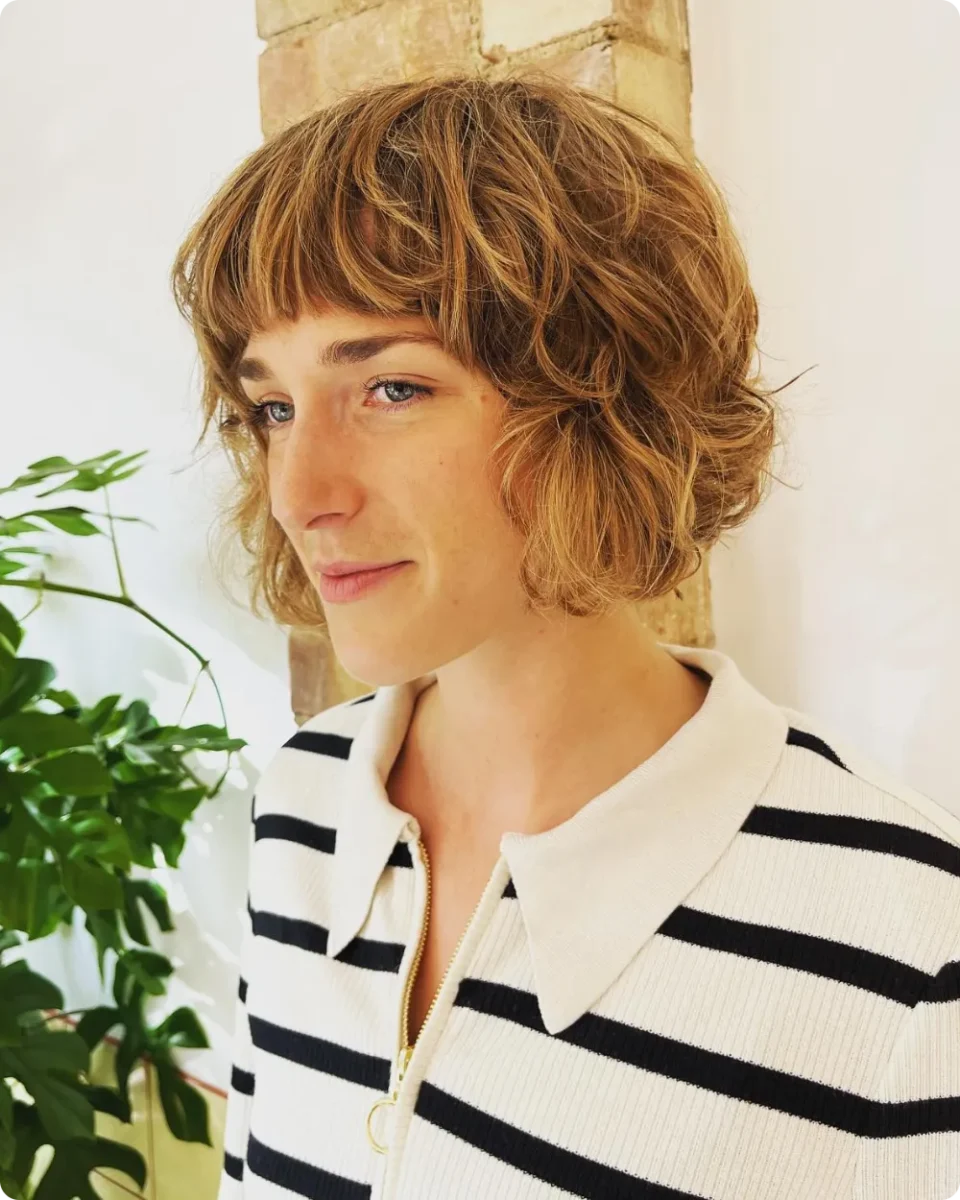
Curly hair sits higher than straight hair, and that changes where a bob should land.
Look at where this one stops. The curls end right around the jaw when dry, which means it was cut with the shrinkage already figured in. The shape is fuller through the middle and lighter at the ends, so it holds a soft round outline without spreading out at the sides.
The fringe is the part worth studying. It falls just below the eyebrows, curls slightly rather than lying flat, and is cut with gaps so you can still see the forehead through it. A dense fringe on hair like this would puff forward. This one sits.
Warm golden brown with lighter pieces near the front adds depth, which matters more on textured hair than it does on straight hair. Flat color tends to make curls read as one solid mass.
Ask for the cut to be done on dry hair, curl by curl. Wet cutting on wave like this is how a jaw-length bob turns into a cheekbone-length one by the time you get home.
8. Angled Bob With Soft Waves and Longer Front Pieces
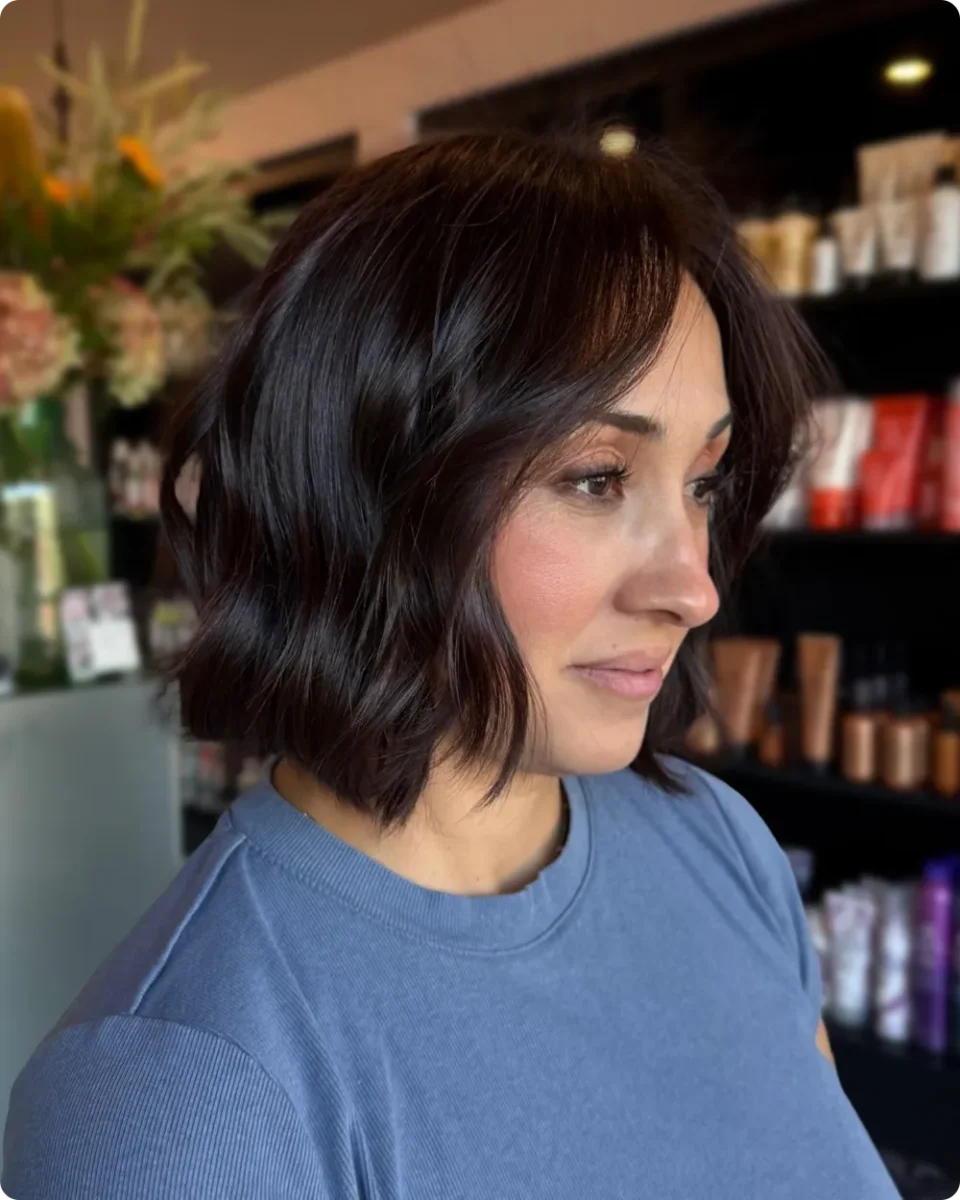
The back is shorter, the front is longer, and the line between them slopes gently instead of dropping off sharply.
That angle is the reason this cut sits the way it does. The shortest section sits near the nape and the length grows as it moves toward the face, so the front pieces finish below the jaw. It keeps the weight forward and lets the back stay rounded instead of flat.
Waves are worked in loosely through the mid-lengths, bending in alternating directions so the shape looks full rather than smooth. A deep side part pushes a heavier panel across the top, and one soft piece falls forward at the temple.
Rich dark brown with a warm undertone catches light through the bends, which is what keeps dark hair from looking like a solid block here.
A good one to bring in if you want short hair but are nervous about the back feeling too exposed.
9. Collarbone Bob With Curtain Bangs and Flipped Ends
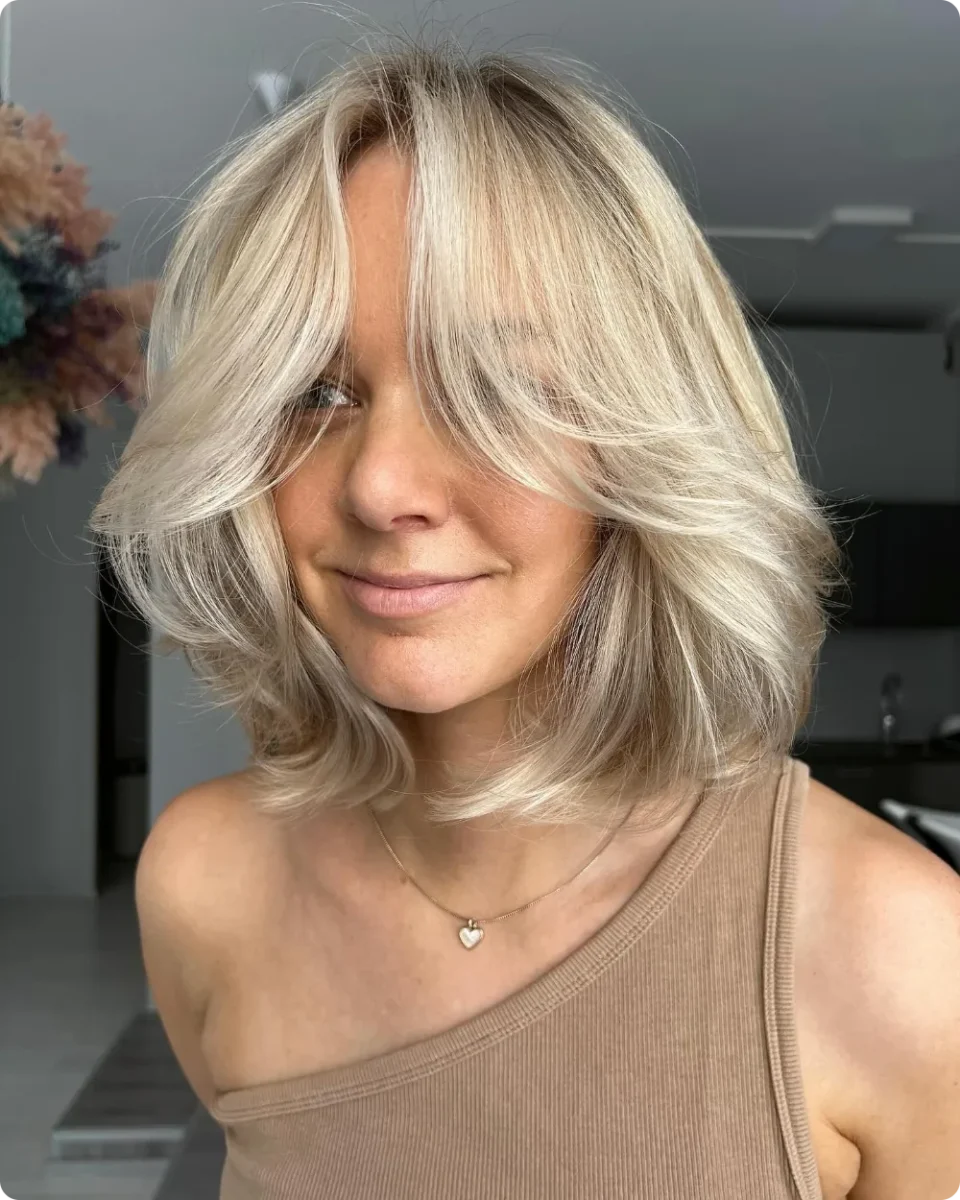
For anyone who wants short hair without losing the ability to tie it back.
This is the longest cut in the set so far, stopping right around the collarbone. The length means the layers can do more without the shape falling apart. The ends flick outward in soft, uneven flips, and the layers underneath are cut so they show through rather than hiding under the top section.
The bangs split down the middle and sweep out to both sides, long enough to blend into the front layers instead of stopping abruptly. That is the difference between curtain bangs and a grown-out fringe.
One styling detail that matters more than the cut: the ends are turned out, not under. A large round brush or a flat iron flicked away from the face at the last inch is all it takes, and it opens up the whole shape.
Bright cool blonde with soft roots keeps the layering visible. On a single flat shade, all this movement would be much harder to see.
⚠️ Watch Out
Ask for the shortest layer to sit at cheekbone level or lower. Cut higher than that and the top section lifts away from the rest, which gives you volume you did not ask for and a long wait to grow it back down.
10. Full Curly Bob Shaped Into a Round Silhouette
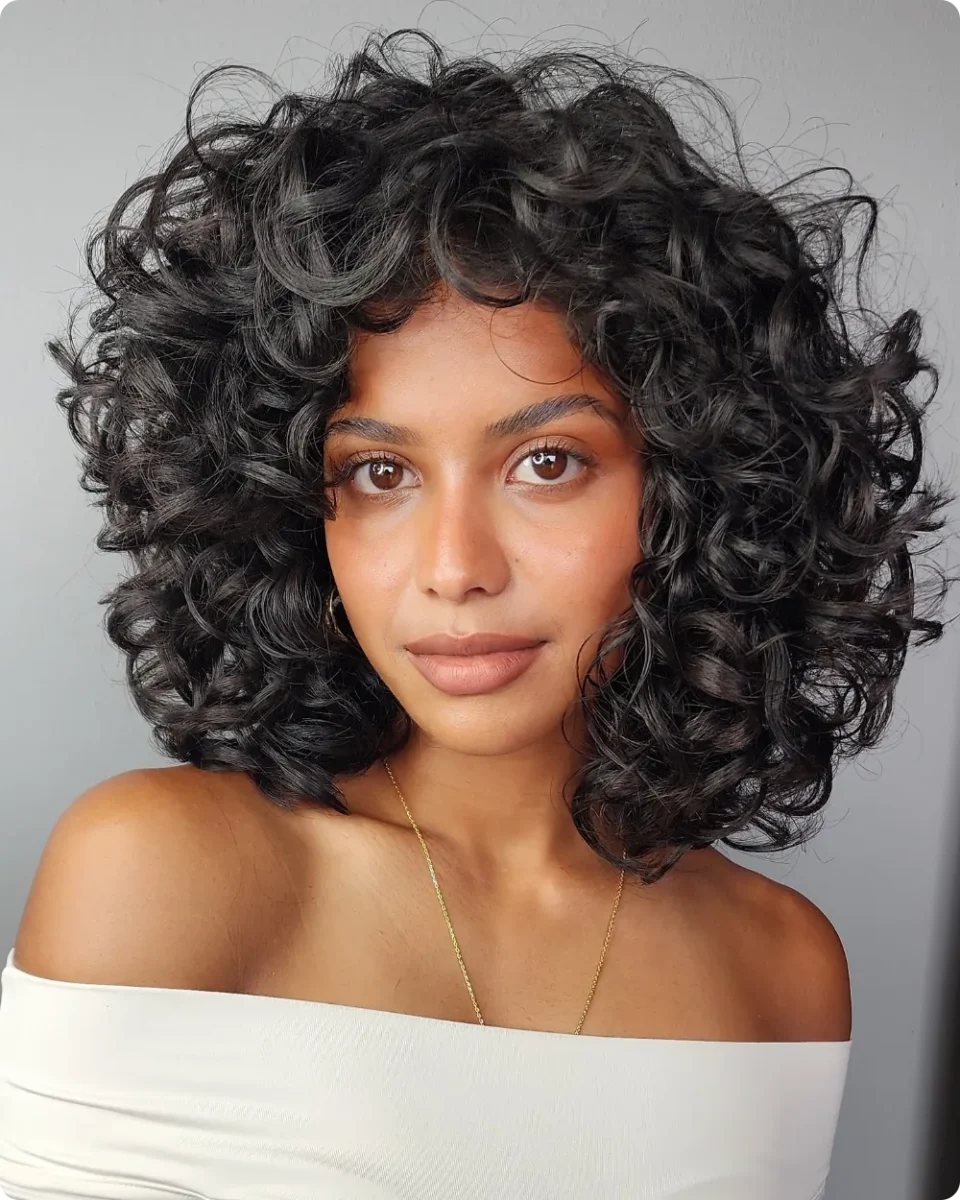
Density is not the enemy here. It is the whole design.
The curls are tight and springy, sitting somewhere between the jaw and the shoulder when dry. Instead of thinning the hair out to control the volume, this cut shapes the outside edge into a rounded outline, widest at the cheekbones and tapering slightly toward the bottom. Nothing is flattened. Nothing is scooped out.
A few shorter curls fall across the forehead, which stops the height at the top from reading too tall. The rest of the length is left alone so the curls stack on each other and hold the shape up.
Deep near-black brown, shiny enough that each curl has a clear edge. Good definition is doing as much work as the scissors.
Thinning shears through the middle to “take the bulk out.” It hollows the curls, and the ends turn frizzy while the top stays full.
Shaping the outline curl by curl on dry hair, so the volume stays and the silhouette gets a clean round edge.
11. Vintage Bob With a Micro Fringe and Rolled-Under Ends
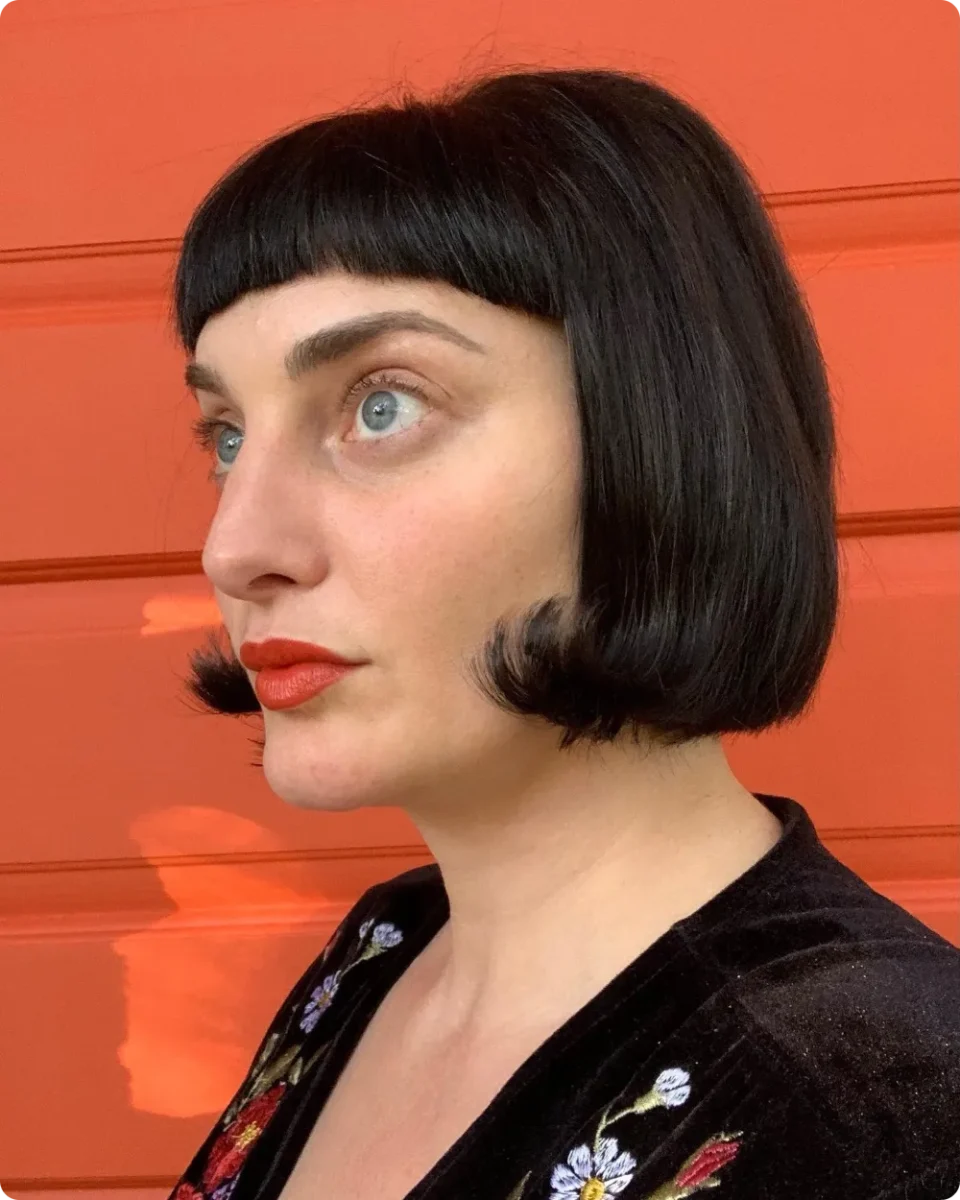
Old school and completely deliberate. Nothing about this one is trying to look casual.
The fringe sits well above the eyebrows, cut straight across with a hard edge, short enough to leave most of the forehead showing. The length ends just under the jaw, and the last inch rolls firmly under so the ends curve toward the neck in a soft tube rather than hanging loose. In front of the ear, one piece breaks away and flicks forward across the cheek, which is the small detail that keeps the whole thing from looking like a wig.
Jet black, high shine, no highlights breaking up the surface. On a shape this precise, flat color is the right call. Anything lighter through the ends would fight the outline.
Ask for it by the parts it is made of, since “vintage bob” means different things in different chairs:
- ▸A fringe that stops about an inch above the brows, cut blunt across.
- ▸One length finishing just below the jaw, no layers anywhere.
- ▸Ends dried under with a round brush so they roll rather than flip.
- ▸A single piece left loose at the temple, curved toward the cheek.
12. Soft Blonde Bob With Long Side-Swept Bangs
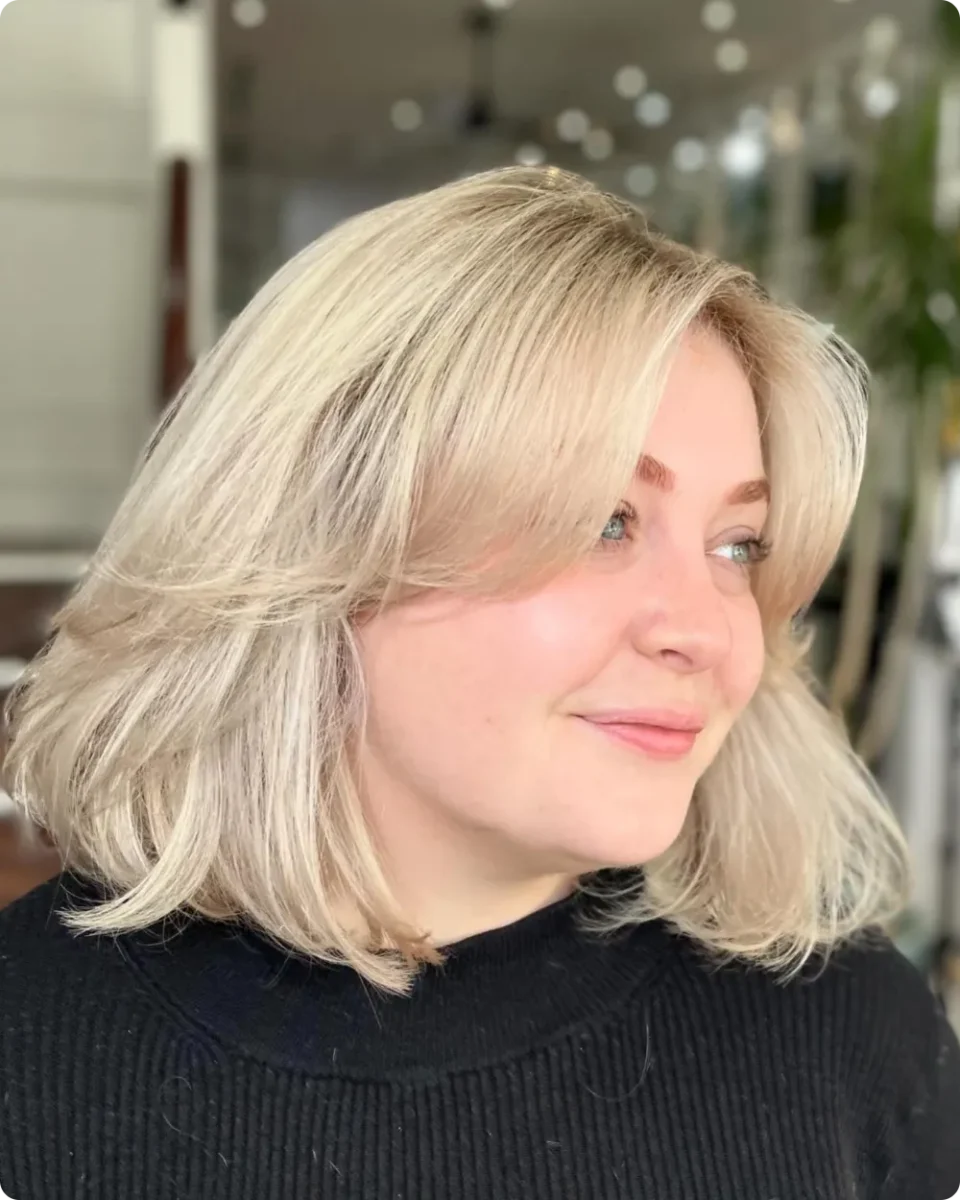
Volume at the roots, weight at the ends, and a fringe that covers as much or as little as you want.
The length sits just below the jaw with the bottom edge left fairly full. Above it, long bangs sweep from a deep side part all the way past the cheekbone, so they blend into the lengths instead of ending on their own. That sweep is what softens the front without cutting anything short.
Light layering shows up only near the bottom, where a few ends separate and turn out. The rest is kept heavy on purpose, which is what gives fine blonde hair a solid outline.
Getting the lift: dry the roots at the crown first, lifting the hair up and back with your fingers before it cools. Most of the shape here comes from that, not from the cut.
Cool creamy blonde with slightly deeper pieces underneath. The darker bits stop the whole thing from washing out into one flat sheet.
13. Middle-Part Bob With Curtain Bangs Falling Into the Length
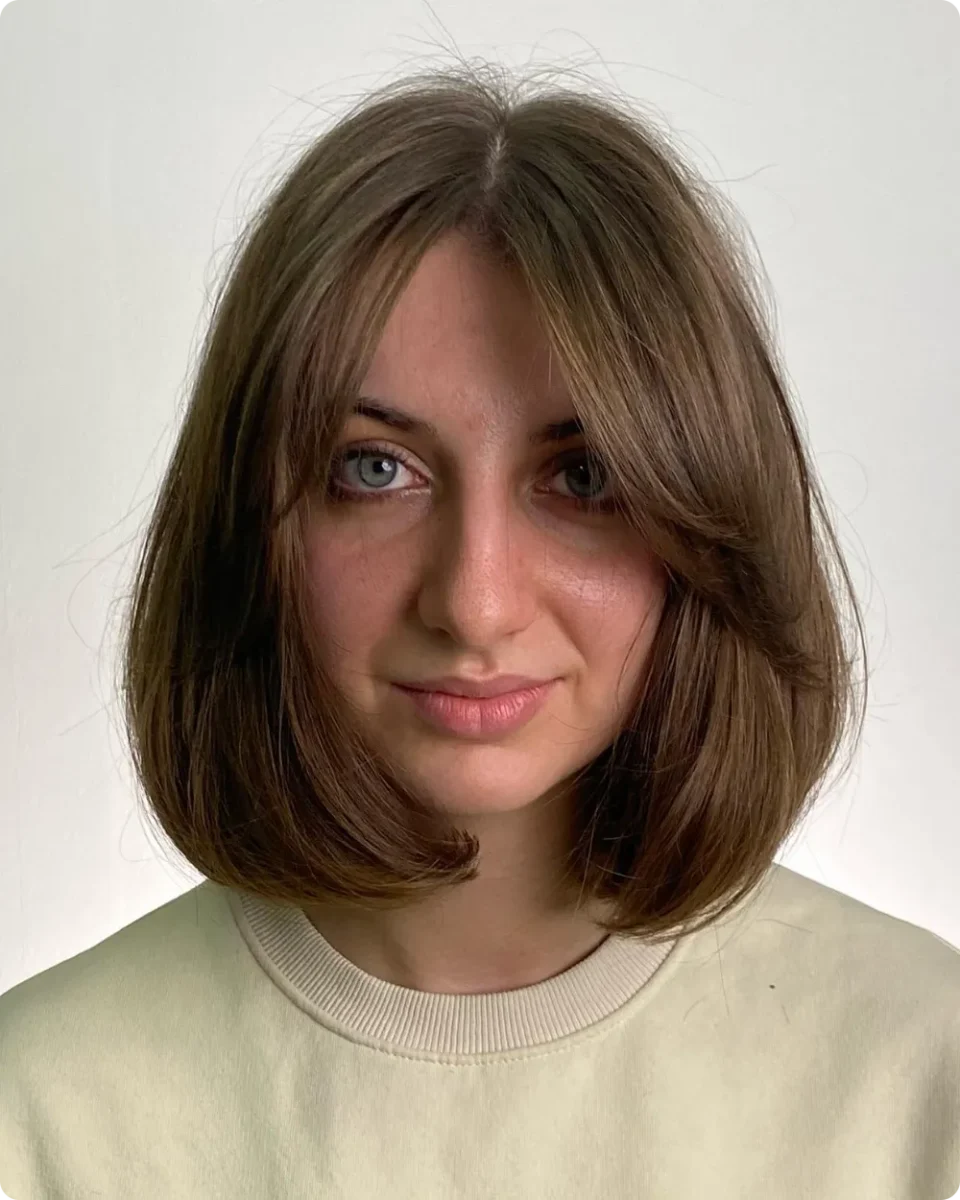
Quiet cut. No sharp angles, no big texture, nothing shouting for attention. That is exactly why it works on so many people.
Bangs split down the centre and fall to either side, reaching past the cheekbones before they disappear into the rest of the hair. There is no visible line where the fringe ends and the length begins. The bob itself stops just above the shoulder, with the ends turning in slightly and a bit of extra weight held at the bottom.
Mousy brown, natural, no highlights doing extra work. What you are seeing is the shape alone.
Here is the argument for it: this is one of the easiest bobs to grow out. The bangs lengthen into face-framing pieces on their own, the middle part stays correct at any length, and there is no strong line that starts looking wrong after six weeks.
Not the most dramatic cut in this list. Probably the most wearable.
💡 Quick Tip
If you are cutting short for the first time and want a safe starting point, this is it. Ask for the length to sit at the top of the shoulder rather than above it. You can always take more off at the next appointment, and this length still tucks into a small clip.
14. Deep Side-Part Bob With Big Bouncy Body
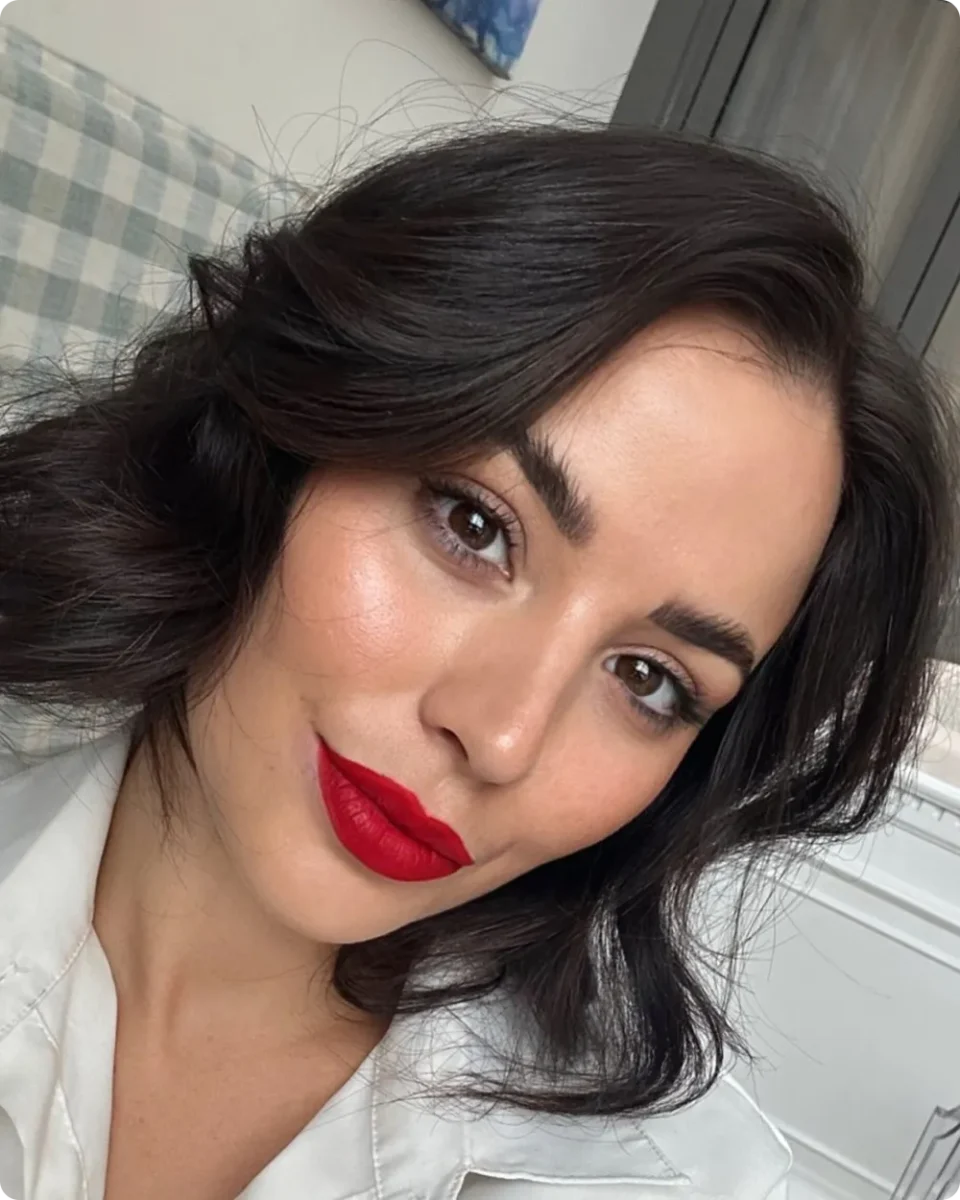
Old Hollywood energy, done without a single pin curl.
A hard part sits far over to one side, and a thick section of hair sweeps across the forehead before falling down past the cheek. That much weight on one side is what creates the lift at the crown. On the other side, the hair tucks closer to the head, so the two sides are deliberately uneven.
The length reaches somewhere around the jaw and turns out in large, soft bends near the ends. Big barrel, brushed out after, nothing tight or set.
Dark espresso brown with a strong shine, which is doing a lot here. Bends this loose only show up on hair that reflects light.
One honest warning. A deep part like this exposes the roots on the heavy side. If you colour your hair, that line shows up fast, and moving the part to hide it also flattens the volume that makes the style work.
| Deep side part | Middle part |
|---|---|
| Lifts the crown and adds height. | Sits flatter, lets both sides fall evenly. |
| Covers one side of the forehead. | Opens the whole face up. |
| Needs a brush and a bit of effort each morning. | Falls into place on its own. |
| Shows regrowth sooner along the parting. | Spreads regrowth across a narrower line. |
15. Feathered Bob in Two-Tone Pink
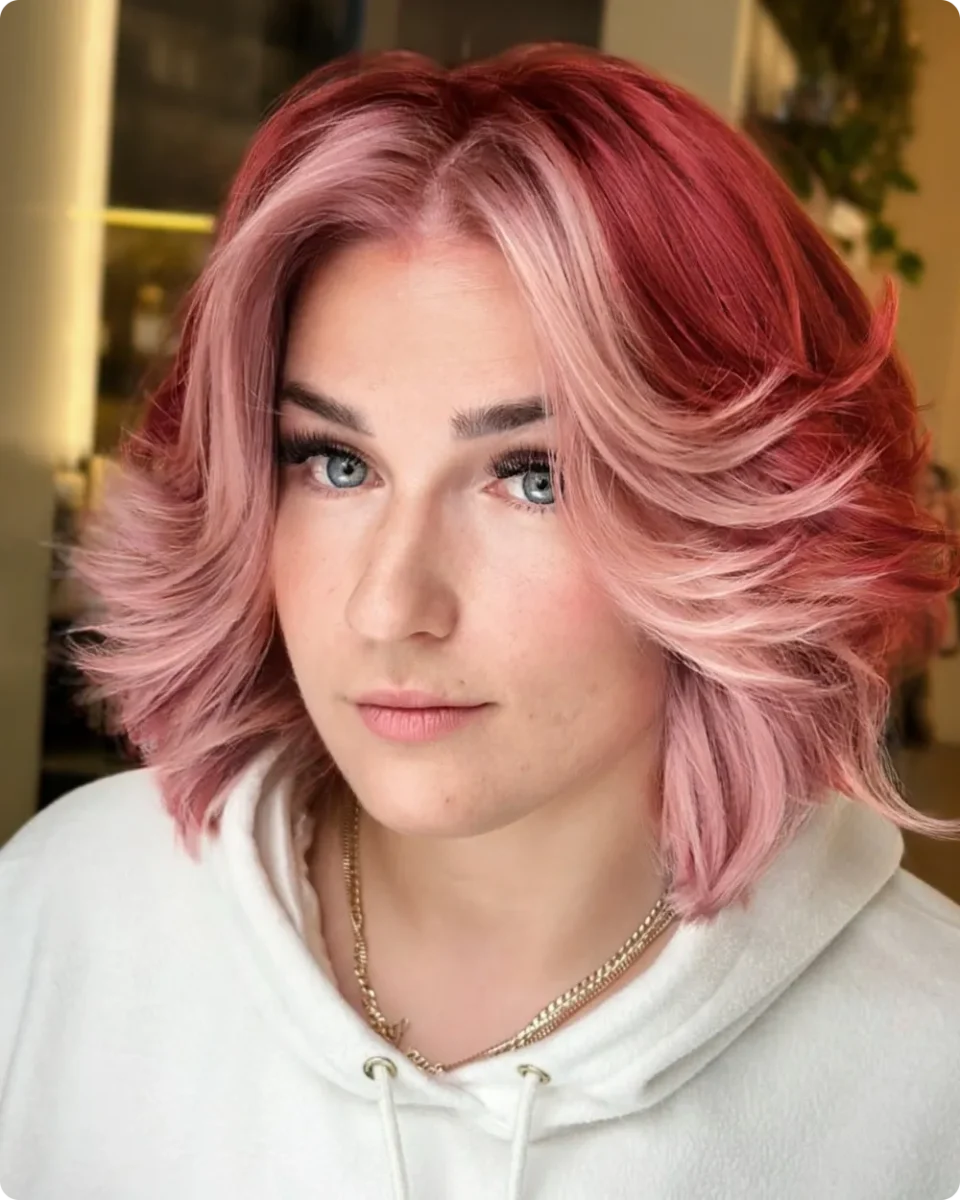
Colour and cut were planned together here, and you can tell.
The shape is layered and feathered, with the ends flicking outward in wide sweeps rather than falling straight down. Every layer catches a different amount of light, and that is where the colour comes in. A deeper red sits underneath and toward the back, with soft pink running through the top and the face-framing pieces. As the layers move, you see both shades at once.
Length lands just above the shoulder, a little longer at the front than at the back.
The lesson worth stealing, even if pink is not for you: put the lighter shade where the layers show and the deeper one underneath. It makes a layered bob look twice as full.
16. Short A-Line Bob With a Lifted Back and Shadow Root
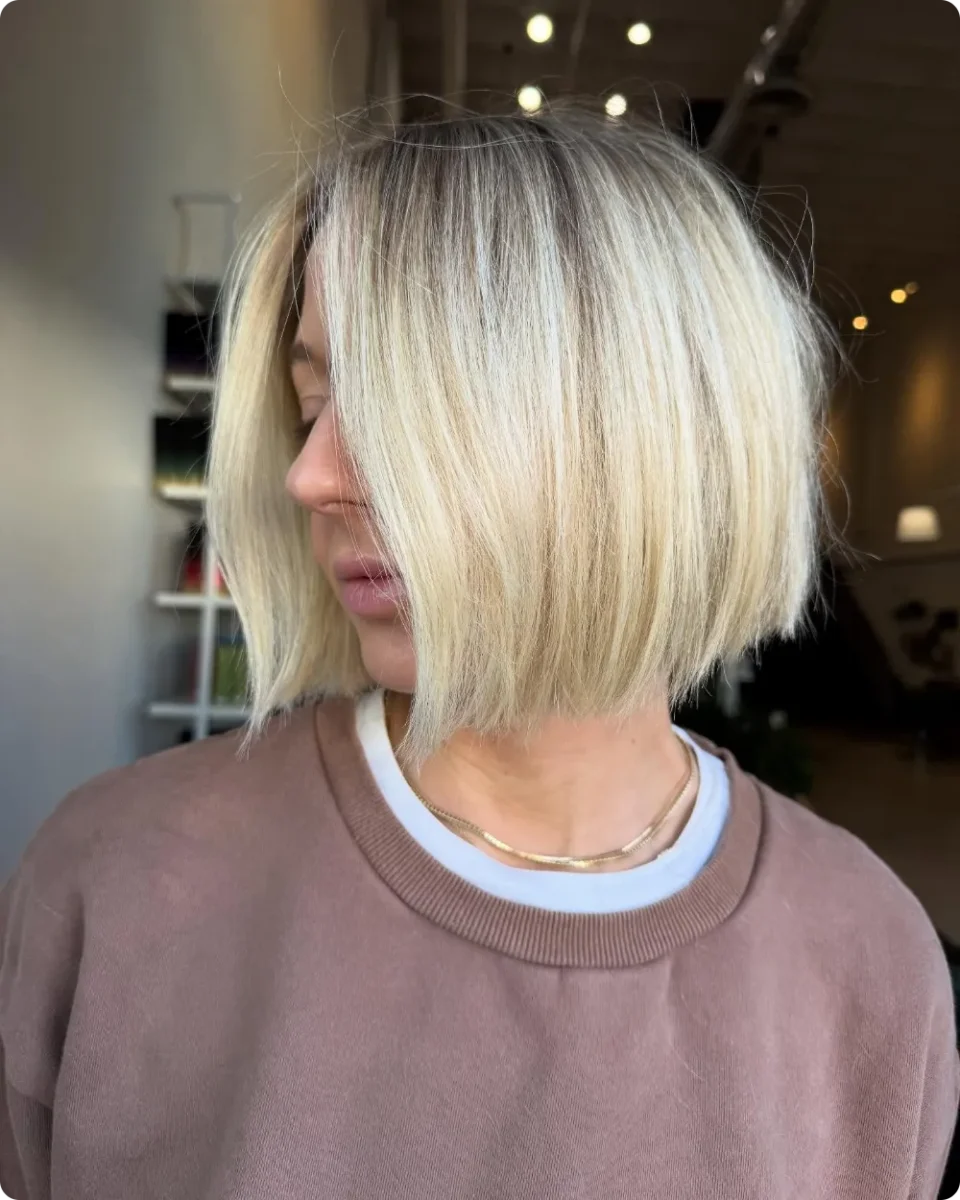
Shorter at the back, longer at the front, and steeper than the angled bob earlier in this list.
The nape sits high, well above the collar, and the line climbs quickly toward the front where the longest pieces reach the jaw. That tilt does two things. It keeps the back off the neck entirely, and it stacks weight underneath so the back of the head looks rounder instead of flat.
The ends are cut with a slight edge, not blunt but not soft either. You can see individual pieces at the bottom, which keeps a cut this short from looking solid.
A darker shadow at the roots blends into bright blonde through the lengths. Practical as much as anything, since a short cut like this needs frequent trims and a soft root buys you time between colour appointments.
A short back means a trim every four to six weeks to hold the angle. Ask your stylist what it looks like at eight weeks, and decide if you are happy living with that version too.
17. Choppy French Bob With a Baby Fringe
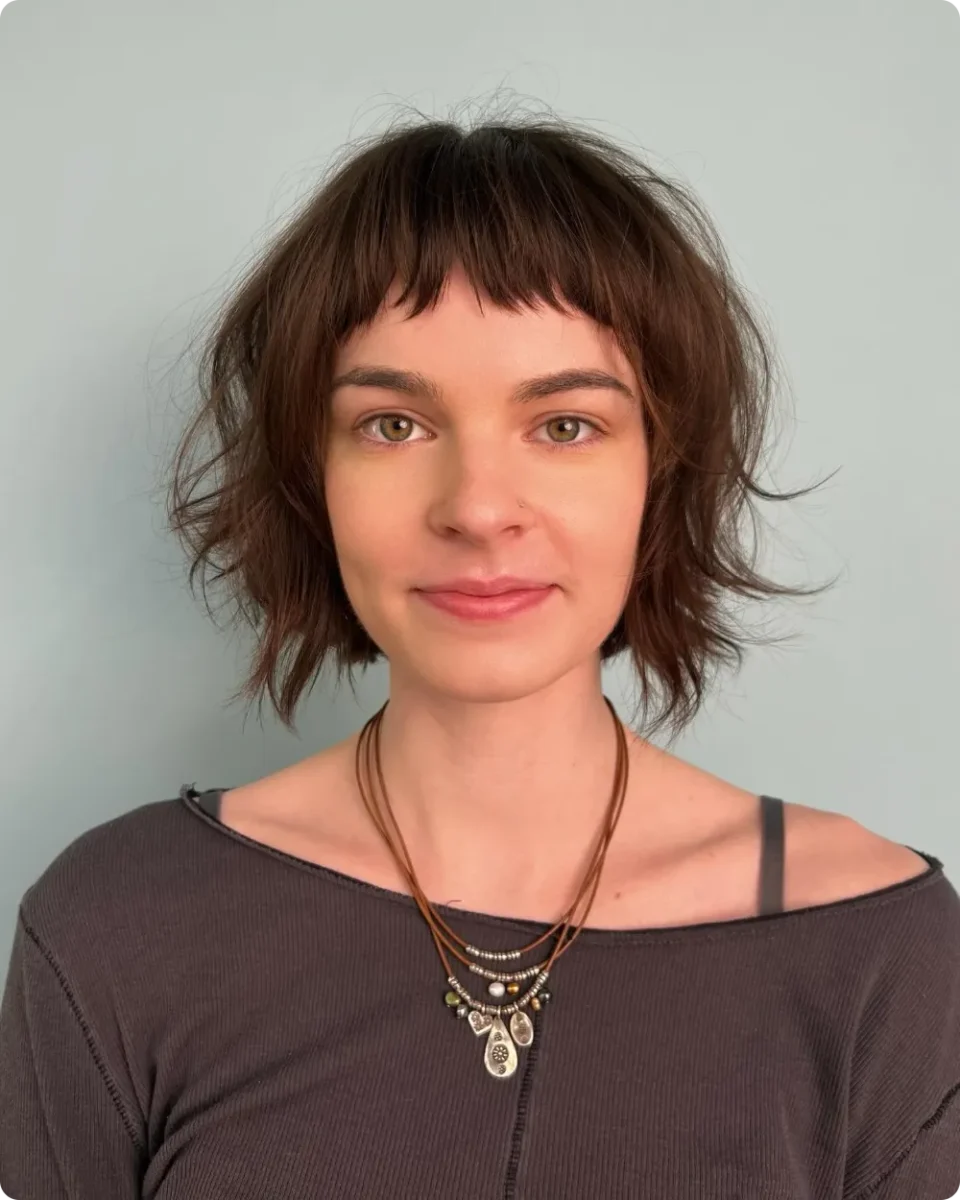
Short, rough, and cut to look slightly grown out from day one.
The fringe ends around mid-forehead, well above the brows, with an uneven bottom edge and visible gaps between the pieces. It is not a straight line. The length falls near the jaw and the ends are chopped, so the outline breaks apart into separate strands rather than holding a curve.
Through the sides, the hair kicks out in different directions, wider around the ears than at the bottom. That extra width near the cheekbones is what balances a fringe this short.
Warm chestnut brown, dry-looking in a good way, no shine products smoothing it down.
Worth saying plainly: this is a high-confidence cut, not a low-effort one. It looks undone but it needs the right texture and the right fringe length to sit correctly.
Ask for the fringe to be cut dry so the shrink-up is visible as it happens.
Request soft, uneven ends through the fringe, not a straight line.
Use a dry texture spray at the roots and leave the ends alone.
Flat ironing the lengths smooth, which kills the whole point.
Cutting the fringe this short if you like wearing it pinned back.
Shine serum through the mid-lengths.
18. Ear-Length Bob That Tucks Behind the Ears
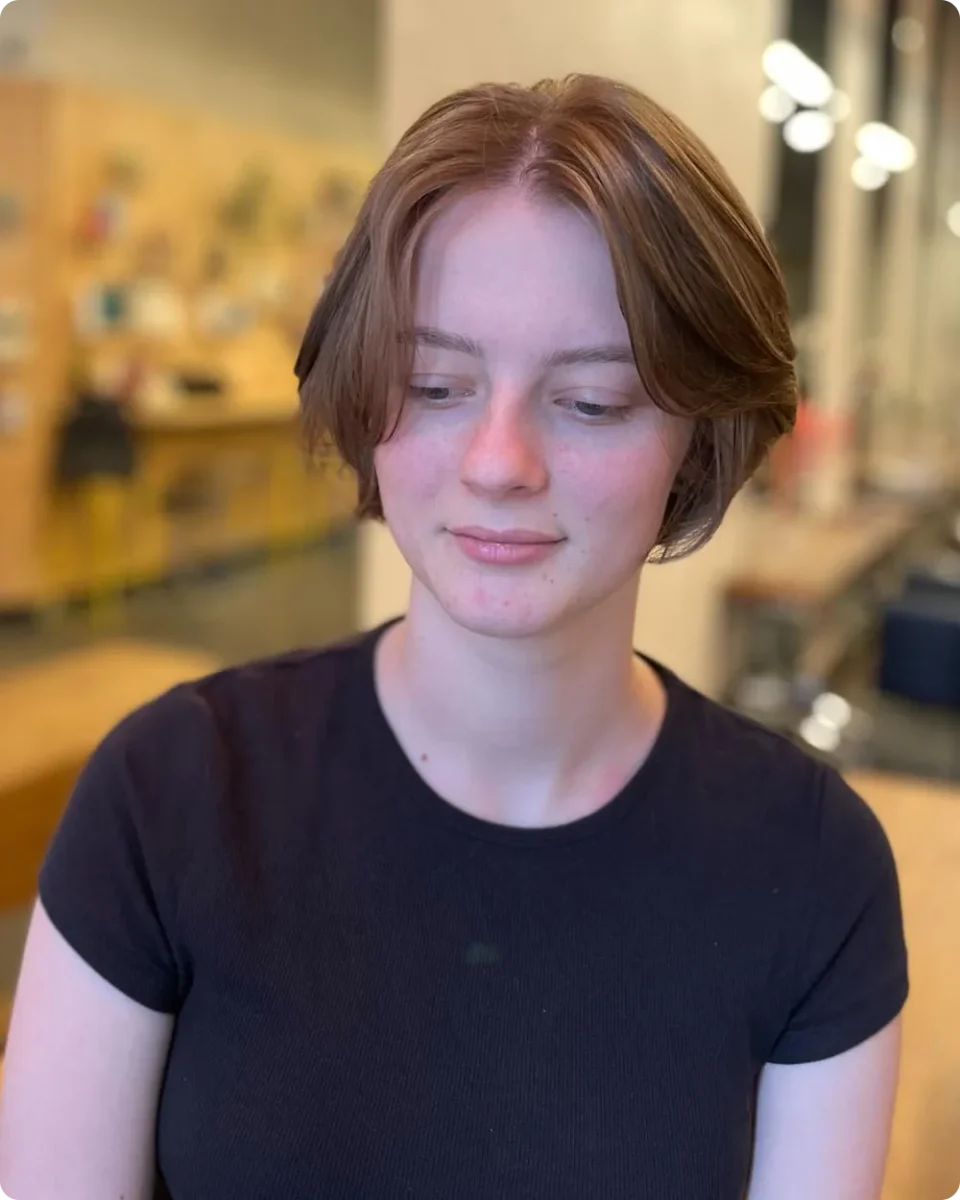
Cropped high, close to the head, and almost no length below the jaw.
The bottom edge sits around ear level, with the shortest sections just behind the ears and slightly longer pieces coming forward toward the chin. Both sides tuck back neatly, which is really the defining feature. A bob only tucks this well when the sides are cut short enough to stay put without a pin.
A centre part sends soft, rounded sections over each side of the forehead. They curve rather than fall straight, so the top of the shape stays full while the sides sit close.
Warm copper-brown with lighter pieces catching the light near the front. Fine hair benefits from this, since a bit of colour variation reads as extra thickness.
Good for anyone who keeps pushing their hair back all day. This is the cut that lets it stay there.
Take a photo of yourself with your hair tucked behind both ears. That is roughly the silhouette you are asking for.
Ask for the sides to finish at ear level and the front pieces to stay a little longer.
Say whether you want your ears fully showing or half covered. It changes the cut by an inch either way.
Check the back with a hand mirror before you leave, since this is the length where the nape starts to matter.
19. Wavy Shag Bob With Shorter Layers Through the Crown
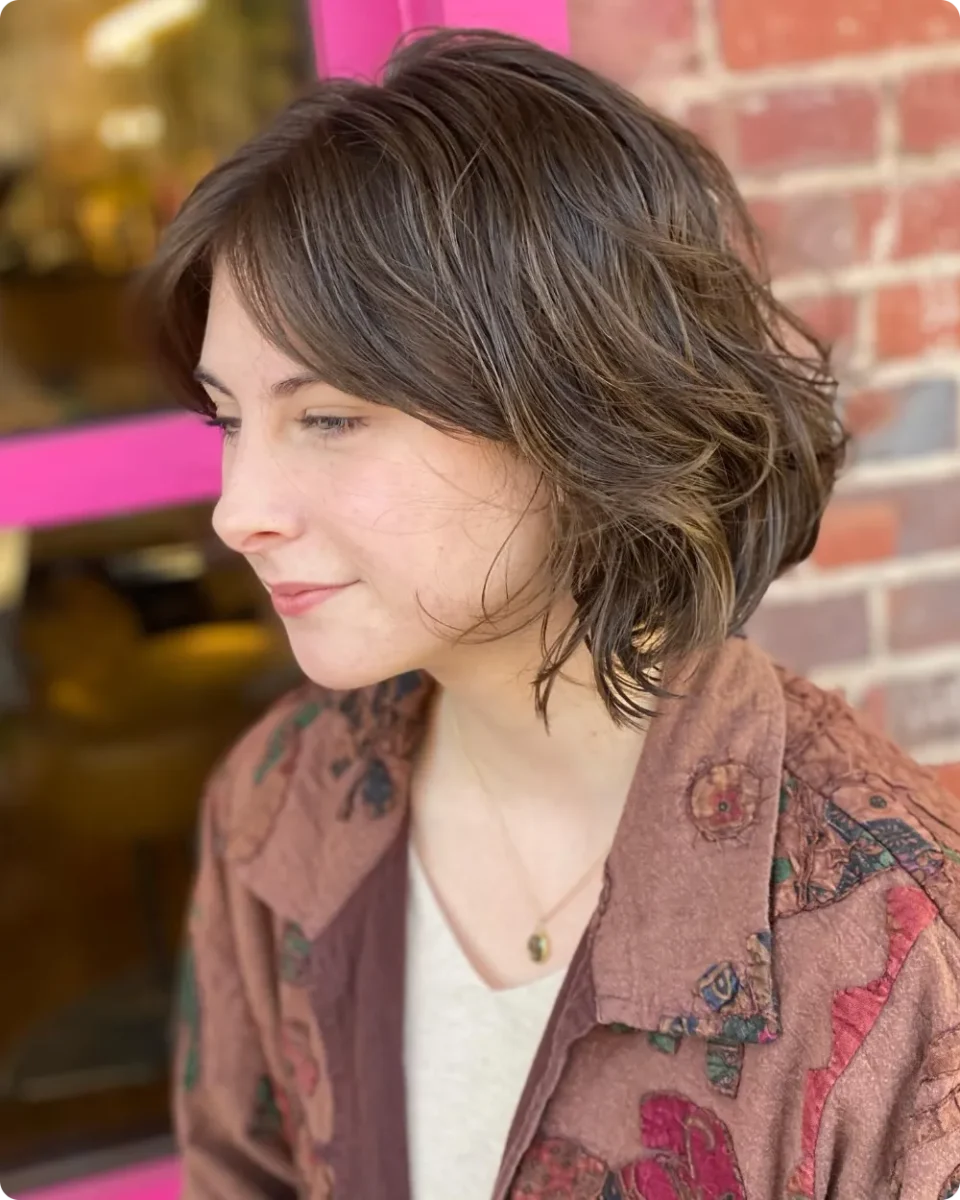
Height on top, movement at the bottom, and the two connected by layers that get gradually longer.
The shortest pieces sit around the crown, which is where all the lift comes from. From there the layers lengthen down the back and sides until the ends land near the jaw. Those ends are wavy and separated, some flicking out, a few curling toward the neck.
Near the face, fine strands fall loose along the cheek and in front of the ear, softer and shorter than the rest.
Medium brown with cooler and warmer pieces mixed through, so the layers read as depth rather than as lines.
Before you commit: a shag needs hair with natural texture to sit like this. On stick-straight hair, the crown layers can look spiky and the ends go limp. Ask your stylist honestly whether your hair wants to do this or whether you would be fighting it every morning.
Signs your hair will take this cut well
20. Polished Bronde Bob With a Smooth Side Sweep
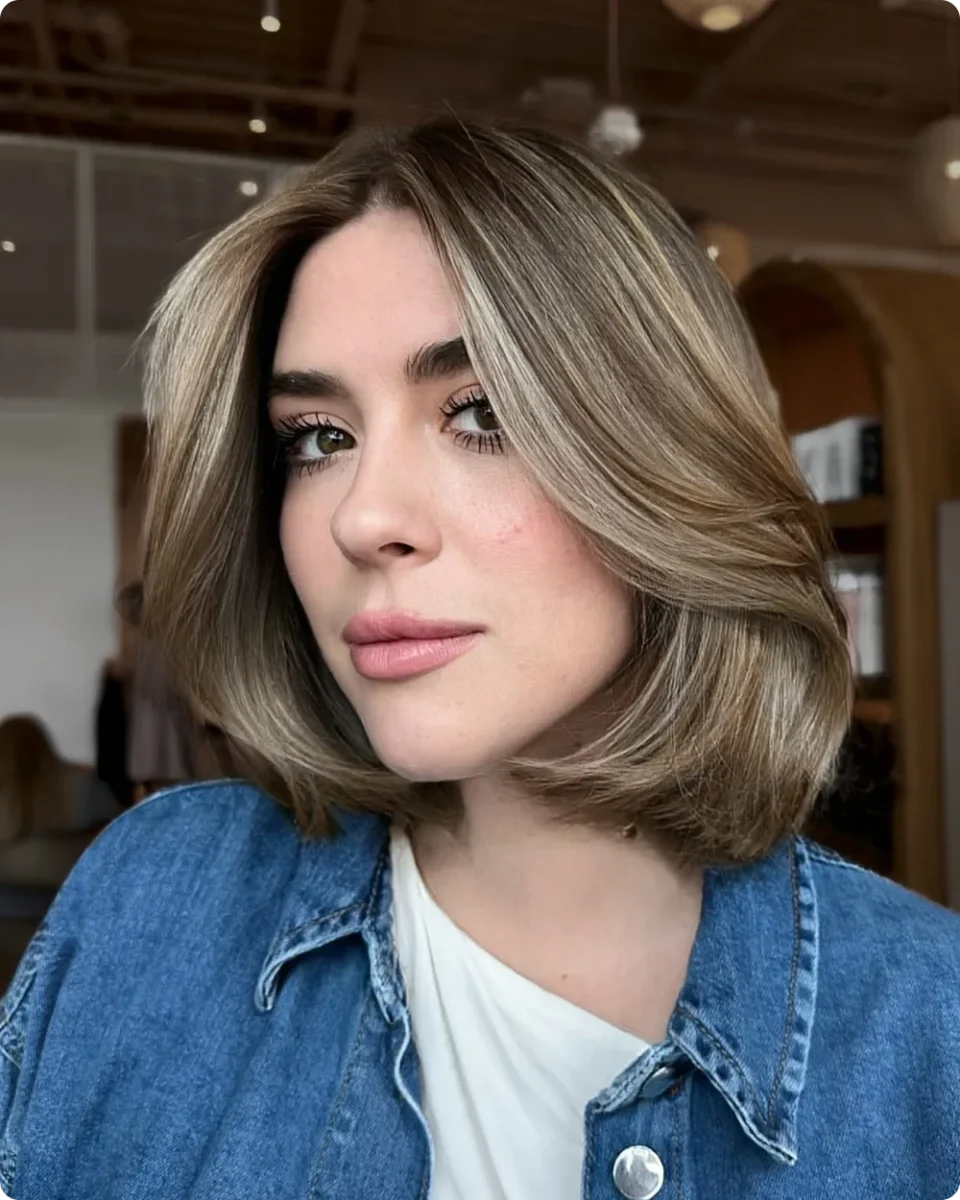
Blow dry bar finish, and it is the styling that does most of the talking.
Length sits just below the jaw with a heavy, even bottom edge. The part is slightly off centre, sending a wide smooth section across one side of the forehead and down past the cheekbone. Everything is brushed in one direction, so the surface stays glossy and unbroken until the last inch, where the ends turn under in a wide soft curve.
The colour is the reason this reads expensive. A darker base with cool sandy highlights woven through the top layers, brighter near the face and deeper underneath. Nothing striped, nothing obvious.
For anyone whose hair is neither dark nor blonde and who has never known what to ask for, this is the shade to point at.
21. Air-Dried Brunette Bob With Soft Side-Swept Bangs

Cut at the chin, then mostly left alone.
The ends are uneven and bend in whatever direction they want, which is what natural texture looks like when nobody flattens it with an iron. Length sits right at the chin with the front pieces just slightly longer, so both sides angle forward a little. The bangs sweep across the forehead from a side part and blend into those front pieces without a hard stopping point.
Cool medium brown, no highlights, a bit of natural shine near the roots and drier texture through the ends.
Why the bangs work at this length: they are long enough to tuck behind an ear on a day you cannot be bothered, which is the whole reason side-swept beats a straight fringe if you are new to bangs.
💡 Quick Tip
Tell your stylist you plan to air dry this. It changes how they cut it, since ends meant to dry on their own need less weight taken out than ends that will be smoothed with a brush every morning.
22. Platinum Lob With Big Volume Through the Sides
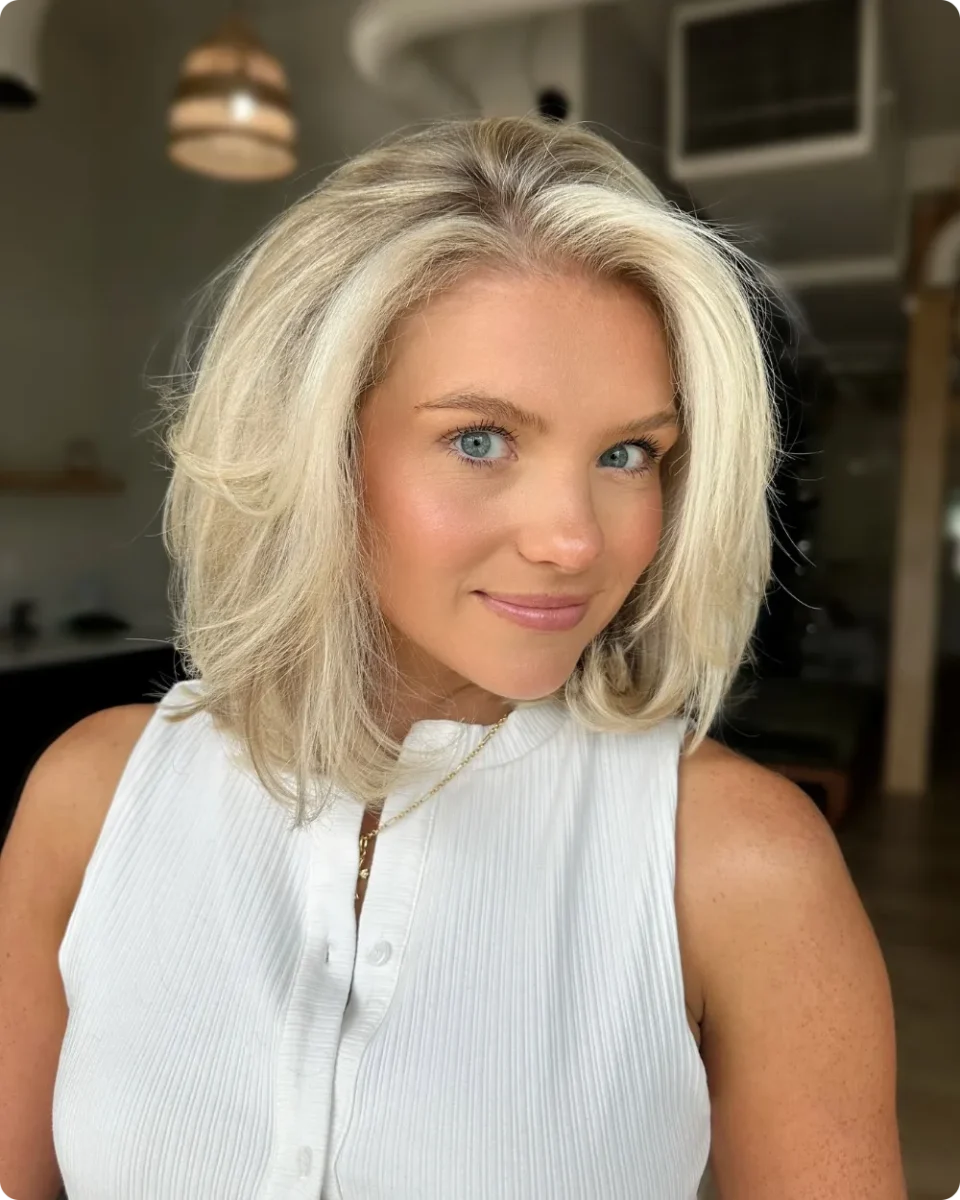
Volume is the point here, and the length is built around it.
The cut reaches the shoulder, but very little of it hangs straight down. Layers through the mid-lengths lift the hair away from the head at the sides, so the widest part of the shape sits around the jaw rather than at the bottom. The ends flick outward in loose sections, and a side part adds height at the crown.
Icy platinum with a soft shadow at the roots. That shadow is doing real work on a blonde this bright. It keeps the regrowth line gentle and stops the colour from looking like a solid white cap under the light.
No fringe anywhere. The face-framing pieces simply start at the cheekbone and get longer from there, which keeps the front open.
23. Shaggy Bob With a Full Brow-Skimming Fringe
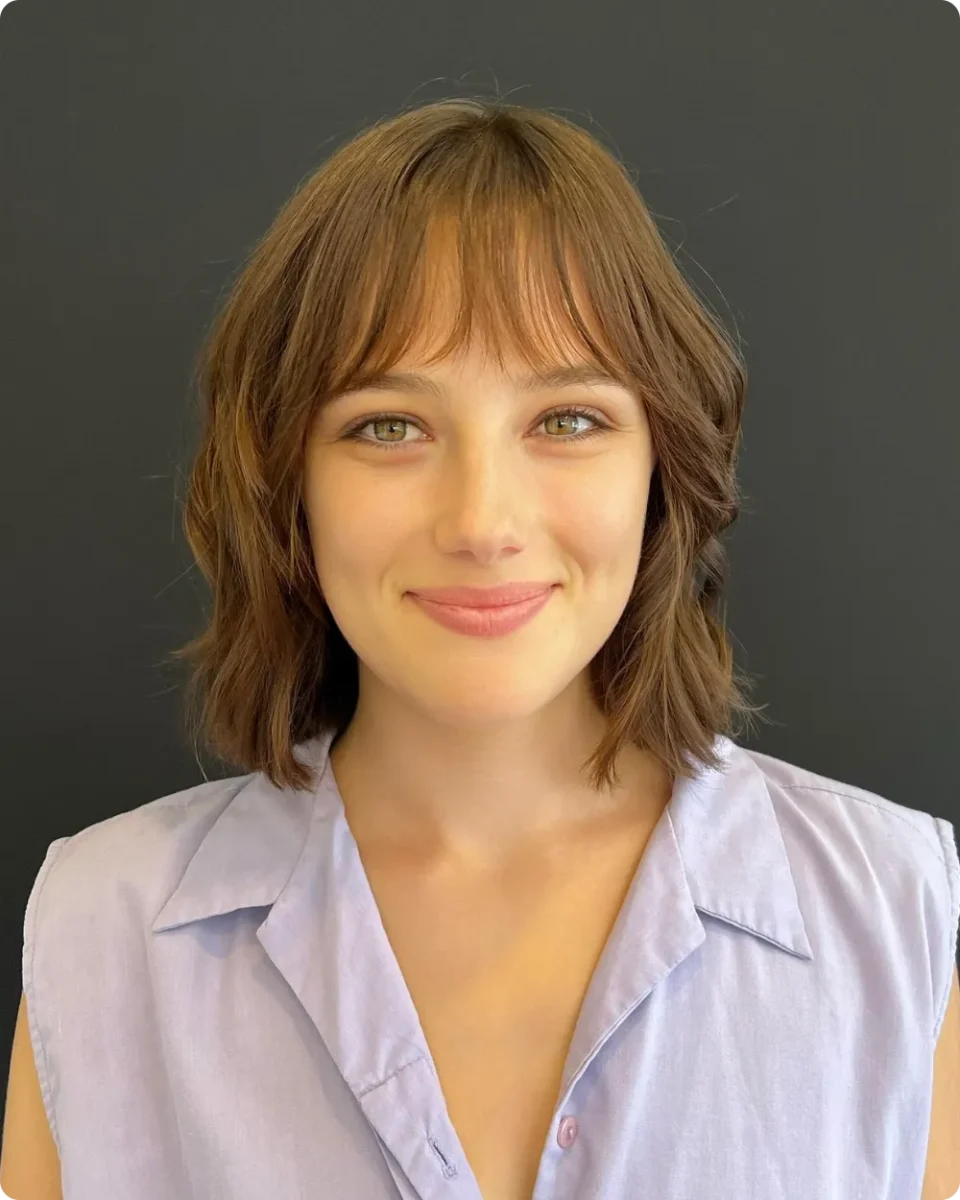
The fringe runs the whole width of the forehead, temple to temple, and stops right at the eyebrows.
Full is the word, not heavy. The bottom edge is soft and slightly see-through, with fine pieces breaking up the line so it never looks like a solid curtain. At the outer corners it lengthens and merges into the face-framing pieces rather than ending abruptly.
Below that, the cut falls somewhere between the jaw and the collarbone with light waves and chopped, separated ends. Short layers around the cheekbones lift the sides so the width sits up near the face instead of pooling at the bottom.
Warm auburn-brown, with lighter pieces near the fringe catching the light.
A fringe this wide takes a large section from the front of your head. Worth knowing if your hair is fine, because whatever goes into the fringe comes out of the length.
A wide fringe needs width lower down to balance it. The short layers at the cheekbones are not decoration here, they are what keep the head from looking top heavy.
24. Wavy Bob With a Short, Curved Fringe
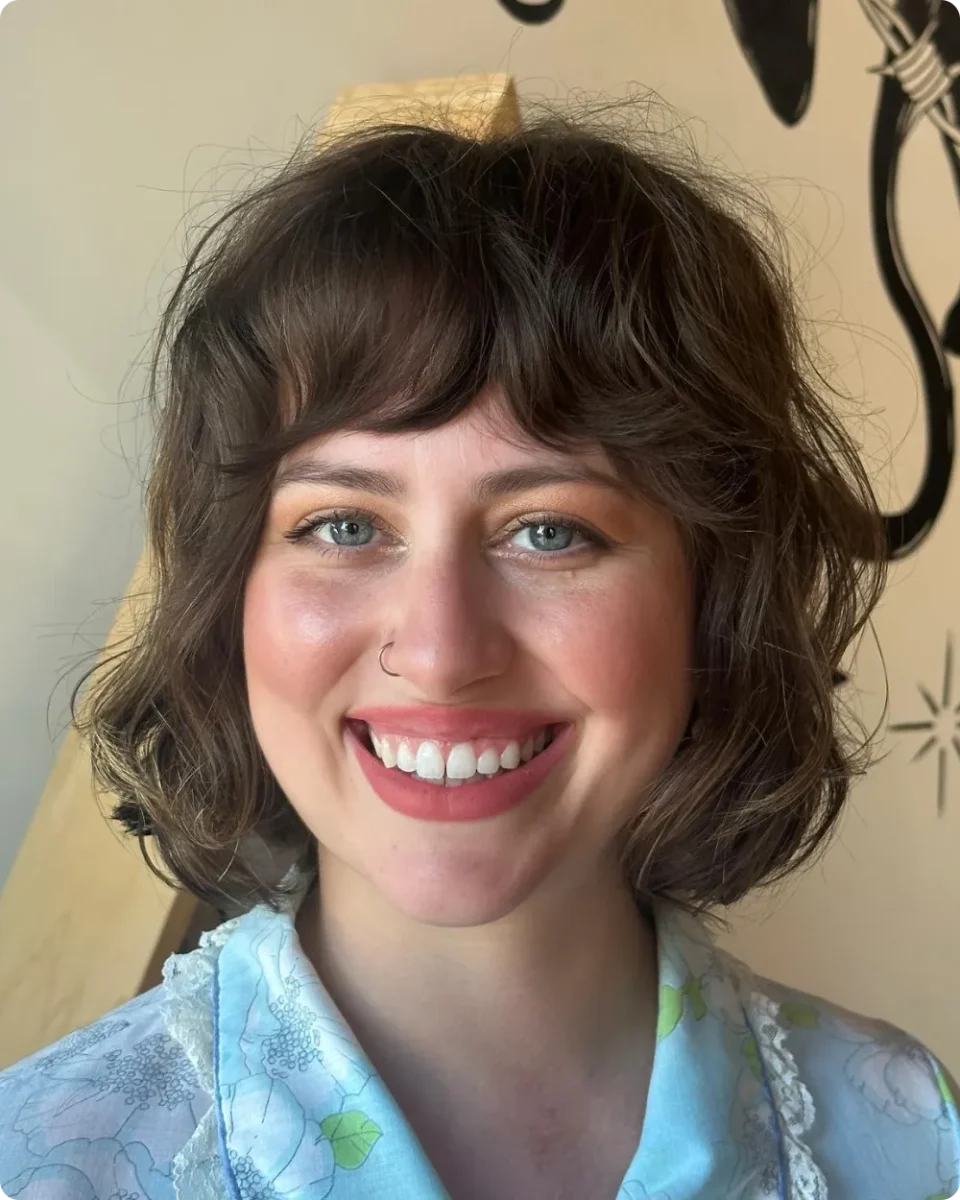
Natural wave left in, and the fringe cut to sit on top of it rather than against it.
The fringe ends above the brows and curves gently down at the sides, following the wave instead of being forced into a straight line. It splits slightly in the middle where the hair wants to part, and that gap is left alone rather than dried flat.
Length sits at the jaw. The waves bend in and out through the sides so the shape is fullest around the ears and lighter at the bottom where the ends separate. There is real volume at the crown, which happens naturally on wavy hair when nobody brushes it out.
Medium brown with warmer pieces showing through the top of the waves.
If you have wave and have avoided a fringe because you assumed it would need straightening every day, this is the version that does not.
That wavy hair plus a fringe means straightening the front every single morning so it lies flat against the forehead.
Cutting it a little shorter to allow for the bend, then letting it dry with the wave. It curves on its own and needs nothing.
Twenty four cuts, and the one you keep coming back to is probably telling you something. Maybe it is the length. Maybe it is the fringe, or the fact that every photo you saved has the ends turned out.
Bring two or three pictures, not one. Stylists read shapes better than words, and having a second photo lets you point at what you do not want as clearly as what you do.
Ask what it will look like at eight weeks before you commit. And save these short bob haircut ideas so the pictures are already on your phone when you walk into the salon.
📌 Good To Know
Three questions worth asking at the consultation, before any scissors come out: where exactly will the length sit when it is dry, how much of my hair goes into the fringe, and how often do I need to come back to keep this shape.